

Our Process
What Gets Added to Vegetable Powder
Aug
One ingredient means one ingredient
Four things get added to vegetable powder in this market, and none of them are for your benefit. Here is what they are, why they are there, and how to tell.
The last post was about how a powder is dried, which decides how much of the plant survives. This one is about what happens after the mill — and it is the shorter, cruder problem. Drying badly loses you something. Adding something gets you a bigger pouch for less money.
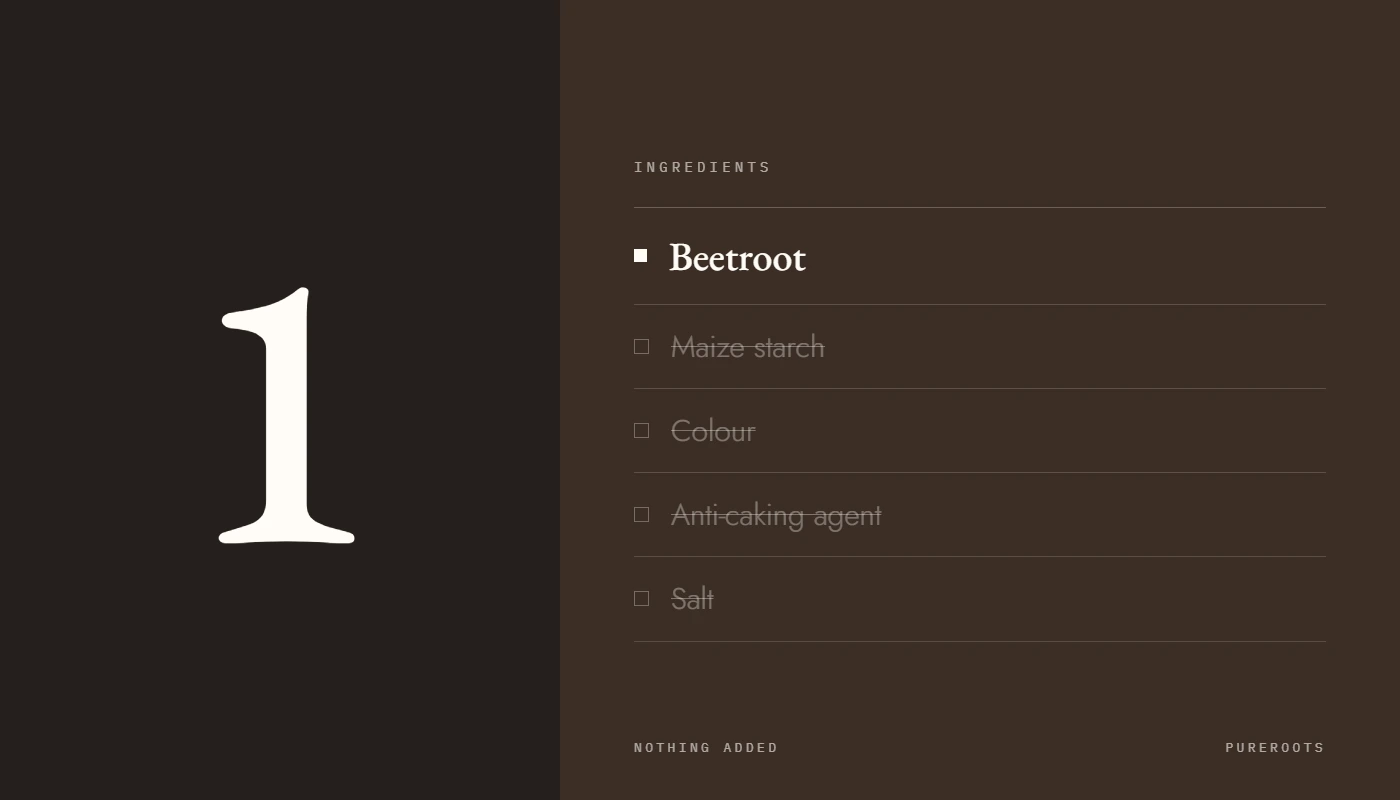
Our ingredients line says one thing, because there is one thing in the pouch. That sentence sounds like marketing until you have read a few competing labels, so let us go through what you will find on them.
Starch, because powder is sold by weight
Maize starch, rice flour and refined wheat flour all look almost exactly like a pale vegetable powder and cost a fraction of one. Blend a quarter of it into garlic or onion powder and the pouch weighs the same, costs a good deal less to fill, and the difference is invisible in a photograph.
You notice it in use rather than in the pack. A cut powder tastes flatter, so you use more of it, so the pouch empties faster — you end up paying the real price anyway, just spread out. It also thickens a gravy in a way pure garlic powder does not, which is the giveaway most cooks spot first without knowing why.
Colour, to cover a drying fault
This is where the two posts meet. Sun drying costs a powder its colour; added colour puts it back. A moringa powder that dried to khaki can be brought to a confident green, and a dull beetroot can be made a red that no beetroot has ever been.
The tell is that added colour overshoots. Real dried plant colour is muted — moringa is a soft grey-green, beetroot a deep earthy red-purple, mint closer to olive than emerald. If a powder looks brighter than the vegetable did, something is doing that work. The other tell is water: stir a spoon into a clear glass and added colour releases fast and evenly, in a way pigment locked in plant fibre does not.
Anti-caking agent, to hide moisture
Powder clumps when there is too much water left in it. The honest fix is to dry it properly and pack it dry. The cheap fix is silicon dioxide or tricalcium phosphate, which keeps a damp powder free-flowing on the shelf and makes an under-dried batch look like a well-made one.
We would rather you saw the truth. Our powders can clump a little in a humid Lahore July, especially the sugar-heavy ones like date, and a lump you can break with a spoon is not a fault — it is what an unadulterated powder does in monsoon air. Keep the zip closed and the pouch out of the sun and it stays loose.
Salt, sugar and “spices”
The most common thing on a garlic or onion powder label after the vegetable itself is salt, and the second is an unspecified “spice blend”. Both make a weak powder taste of something. Neither is disclosed in any useful quantity, which means you are seasoning a dish twice and can only guess by how much.
Single-ingredient powder is harder to sell and easier to cook with. You add the salt. You decide how much. That is the entire proposition, and it only works if the pouch really does contain one thing.
Four tests you can run at home
- The water glass: Half a teaspoon into clear water. A pure powder wets slowly and settles as sediment. Colour that blooms through the water in seconds was added.
- The rub test: Rub a pinch between finger and thumb. Vegetable powder is faintly gritty and holds its smell on your skin. Slippery and smooth with no smell means starch.
- The taste test, undiluted: A quarter teaspoon on the tongue should be uncomfortably strong — that is what concentration tastes like. Mild is not gentle, it is diluted.
- The dosage check: If a recipe needs two spoons of a powder where one should do, you are buying filler by weight.